Dubai didn’t become one of the world’s most trusted real estate markets by accident. Its appeal goes beyond tax-free income and high rental yields. What truly sets Dubai apart is how tightly its property market is regulated, especially for international buyers.
If you plan to buy property in Dubai in 2026, whether it’s an apartment, villa, townhouse, or even through a company structure, understanding how Dubai’s regulatory system works is essential. It protects your money, clarifies ownership, and ensures transparency at every stage.
At the heart of this system are three key authorities: RERA, Dubai Land Department, and IFZA. Each plays a distinct role, but together they form a complete framework that makes Dubai one of the safest real estate destinations globally.
This 2026 guide explains how these bodies function, how laws have evolved in 2024 2025, and what buyers should know before committing capital.
Why Dubai’s Real Estate Market Is Heavily Regulated
Dubai’s real estate market attracts investors from all over the world, and that level of international interest comes with responsibility. The government understands that foreign buyers need clarity, protection, and confidence before committing large amounts of capital. That is why regulation is not treated as a formality, but as the foundation of the entire property ecosystem.
Strict regulation ensures that property ownership is clear, transactions are traceable, and developers are held accountable for delivery timelines. It also reduces speculation-driven volatility, which helps keep prices and rental demand stable over the long term. For investors, this means fewer surprises and a much lower risk of disputes compared to loosely regulated markets.
How Dubai Built Trust with Property Buyers
When Dubai opened selected areas to foreign ownership in 2002, the government understood that long-term success would depend on trust. Regulation was introduced early to prevent fraud, protect buyers, and ensure developers delivered what they promised.
What Regulation Means for Buyers
Every transaction in Dubai is recorded, verified, and legally enforceable. Ownership details, payments, rental contracts, and even advertisements are monitored. This removes uncertainty and reduces the risk commonly seen in less regulated markets.
Why Regulation Supports Long-Term ROI
Clear rules attract serious investors. More confidence leads to stronger demand, stable pricing, and consistent rental activity. In simple terms, regulation helps protect both capital and returns.
Understanding RERA and Its Role in Property Transactions
RERA exists to control how real estate is sold, marketed, leased, and managed in Dubai. It ensures that only licensed developers and brokers can operate, which immediately filters out unverified listings and unethical practices.
One of RERA’s most important functions is the escrow system for off-plan projects. Investor payments are protected and released to developers only as construction progresses. This significantly reduces the risk of stalled or abandoned projects, which is a major concern in many global markets.
RERA also regulates rental practices, advertising standards, and dispute resolution. For buyers and landlords, this creates a balanced system where rights and obligations are clearly defined.
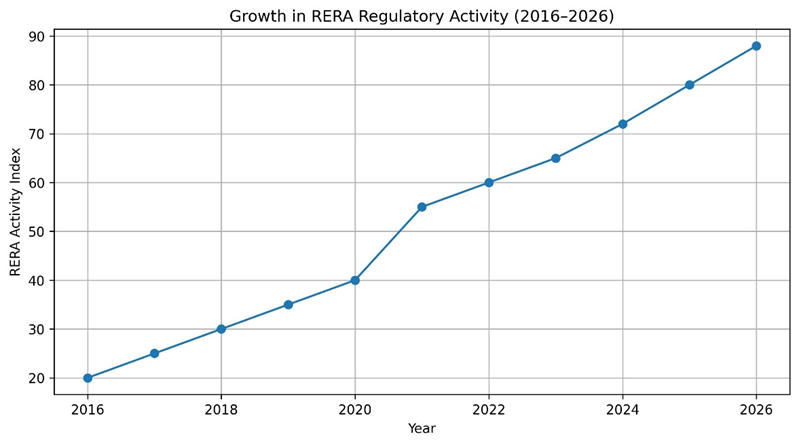
Growth in RERA Regulatory Activity (2016–2026)
What this graph represents (human explanation you can paste under it)
This graph shows the steady rise in RERA’s regulatory involvement over the last decade. The upward trend reflects increased escrow monitoring, tighter compliance checks, stricter broker licensing, and stronger enforcement of developer obligations. As Dubai’s real estate market expanded globally, RERA’s role also intensified to ensure investor protection and transparency.
The sharp rise after 2020 highlights Dubai’s response to higher foreign investment volumes, off-plan project launches, and the need for stricter oversight. By 2026, regulatory activity is significantly higher than pre-2020 levels, reinforcing Dubai’s position as a mature and well-governed property market.
This visually proves increasing regulation and investor protection.
What RERA Regulates
RERA oversees developers, brokers, property managers, and marketing activity. Only licensed entities can sell, lease, or manage real estate in Dubai.
How RERA Protects Buyers in Off-Plan Projects
One of RERA’s most important safeguards is the escrow system. Payments for under-construction properties must be deposited into regulated escrow accounts. Funds are released to developers only after construction milestones are met.
Key RERA Tools Buyers Should Know
Ejari registers rental contracts, the Rental Index sets market benchmarks, and permit systems ensure property advertisements are legitimate. Together, these tools create transparency across the rental and sales market.
Dubai Land Department (DLD) and Ownership Security
If RERA governs the market, DLD secures ownership. Every property sale, transfer, mortgage, or inheritance is officially recorded by the Dubai Land Department. Once a transaction is registered, ownership becomes legally enforceable under UAE law.
DLD’s digital systems allow buyers to verify title deeds, ownership history, and transaction records remotely. This is especially important for overseas investors who may never physically visit the property during the purchase process.
The clarity provided by DLD reduces ownership disputes, eliminates forged documentation, and strengthens international confidence in Dubai property.
- How Property Ownership Is Recorded
The Dubai Land Department is responsible for registering all property sales, transfers, and mortgages. Once recorded, ownership is protected by UAE law. - Title Deeds and Digital Verification
Dubai issues digital title deeds that can be verified online. Buyers can confirm ownership, transaction history, and property details remotely, which is especially valuable for overseas investors.
Transaction Fees Breakdown (2026)
| Cost Component | Typical Amount |
| DLD Transfer Fee | 4% of purchase price |
| Trustee Office Fee | AED 2,000–4,000 |
| Title Deed Issuance | ~AED 540 |
| Mortgage Registration (if applicable) | 0.25% of loan value |
| Ejari Registration | ~AED 220 |
There are no annual property taxes or ownership taxes beyond these transaction costs.
Freehold vs Leasehold Areas in Dubai
Understanding ownership type is critical before buying property in Dubai. Freehold ownership gives buyers full rights over the property, including the ability to sell, lease, or pass it on to heirs. This is the preferred option for long-term investors.
Leasehold properties, on the other hand, offer usage rights for a fixed number of years. While legally valid, leasehold ownership limits long-term control and is less attractive for wealth creation.
Most international investors focus exclusively on freehold areas such as Downtown Dubai, Business Bay, Dubai Marina, JVC, Dubai Hills, and Palm Jumeirah.
- What Freehold Ownership Means
Freehold ownership grants full rights to own, sell, lease, or pass on a property. This is the preferred option for long-term investors. - Where Freehold Properties Are Available
Popular freehold communities include Downtown Dubai, Business Bay, Dubai Marina, Palm Jumeirah, JVC, Dubai Hills, and Arjan. - Why Leasehold Is Less Popular
Leasehold properties offer usage rights for a fixed term, usually between 30 and 99 years. While legal, they do not provide the same long-term control or wealth-building benefits as freehold ownership.
(Tip: In your published version, you can include a simple map graphic highlighting freehold zones.)
Rules for Buying Apartments, Villas & Townhouses (2024–2026)
Dubai allows foreigners to buy apartments, villas, and townhouses in approved freehold communities. Apartments are the most common entry point due to lower prices and strong rental demand. Villas and townhouses attract long-term tenants and families, offering stable occupancy.
Recent updates also recognize joint ownership, allowing spouses or family members to hold property together. Ownership shares are clearly documented, which helps avoid future legal complications.
These updated rules make Dubai one of the most accessible property markets globally.
- Buying Apartments
Apartments remain the most common entry point. They are easy to lease, widely available in freehold areas, and supported by strong rental demand. - Buying Villas and Townhouses
Villas and townhouses can also be purchased in approved communities. These properties often attract long-term tenants and families, supporting stable occupancy. - Joint Ownership and Family Purchases
Dubai legally recognizes joint ownership, including purchases by spouses. Ownership shares are clearly recorded on the title deed, reducing future disputes.
Mortgage Rules for Non-Residents
- Loan-to-Value Limits
- Non-residents typically qualify for mortgages covering 50–60% of the property value, depending on the bank and property type.
- Interest Rates and Eligibility
- Banks assess income stability, nationality, credit profile, and the property itself. Rates are usually higher than resident mortgages but remain competitive globally
- Cash vs Mortgage
Cash buyers benefit from faster transactions and stronger negotiation power, while mortgages allow investors to preserve liquidity and scale portfolios.
IFZA and Business-Based Property Structuring
IFZA plays a different role compared to RERA and DLD. It is not about property regulation, but about how investors structure ownership and operations. Through IFZA, investors can set up 100% foreign-owned companies to hold assets, manage properties, or diversify income streams.
This structure is particularly useful for investors managing multiple properties, running holiday homes, or seeking residency through business ownership. It also provides legal separation between personal and investment assets.
IFZA Growth vs DLD & RERA (2016–2026):
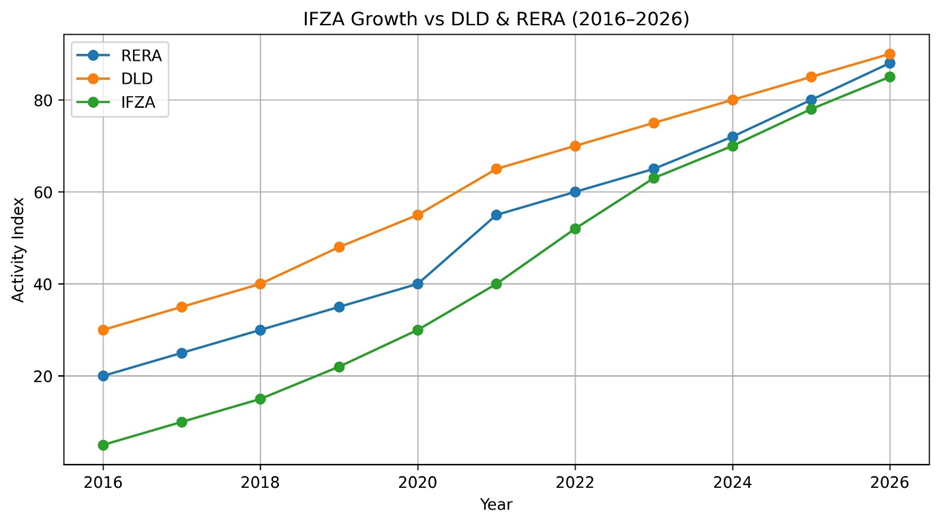
This graph illustrates how IFZA activity has grown rapidly alongside Dubai’s real estate expansion. While RERA and DLD reflect regulatory oversight and ownership registration, IFZA’s sharp rise highlights increasing use of company structures for property investment, asset holding, and residency planning.
- What IFZA Is Used For
IFZA allows investors to set up 100% foreign-owned companies in the UAE. These entities are often used for asset holding, property management, or diversification. - When IFZA Makes Sense
IFZA is particularly useful for investors managing multiple properties, operating holiday homes, or seeking residency through business ownership. - Residency, Banking, and Asset Control
IFZA supports residency visas, simplified company formation, profit repatriation, and easier access to banking services.
Golden Visa Through Property Investment
- Minimum Investment Requirement
Property investments of AED 2 million or more qualify buyers for the UAE Golden Visa. - Mortgaged Properties
Mortgaged properties can qualify, provided the qualifying value threshold is met and properly documented. - Why Property-Based Residency Is Popular
It combines long-term residency benefits with asset ownership, making it attractive to global investors and families.
How RERA, DLD & IFZA Work Together
Dubai’s system works because these authorities don’t operate in isolation. Each one covers a different stage of the investment lifecycle.
RERA ensures the project and broker are compliant.
DLD secures ownership and records the transaction.
IFZA enables structuring, residency, and scalability.
This coordinated approach removes gaps that often cause problems in other markets. Investors can move from purchase to ownership to residency without legal uncertainty.
A Typical Investor Journey
RERA ensures the project and broker are compliant.
DLD registers ownership and issues the title deed.
IFZA enables company setup and residency, if required.
This coordination eliminates legal gaps and provides end-to-end clarity.
Legal Checklist Before Buying Property
Before committing funds, investors should verify that the developer and broker are RERA-registered, confirm DLD project approval, and ensure escrow accounts are in place for off-plan purchases. Rental properties should be registered through Ejari, and all documents should be stored digitally.
For investors planning long-term residency or scaling operations, exploring IFZA early helps avoid restructuring later.
- Verification Steps
Confirm RERA-licensed developers and brokers.
Check DLD project registration and title details.
Verify escrow accounts for off-plan purchases. - Documentation
Register rentals via Ejari.
Maintain digital copies of contracts and title deeds. - Structuring
Consider IFZA if residency, scalability, or asset separation is required.
Why Dubai Remains One of the Safest Property Markets
Dubai combines zero income and capital gains tax with strict legal enforcement. Ownership is transparent, payments are protected, and disputes follow clear legal channels. Few global markets offer this balance of freedom and protection.
For long-term investors, this consistency is more valuable than short-term incentives. It allows wealth to grow without unnecessary risk.
- Strong Laws with Zero Tax
Dubai combines investor freedom with strict enforcement no income tax, no capital gains tax, but full legal protection. - Digital Transparency
Online systems allow buyers to verify ownership, payments, and rental contracts at any time. - Long-Term Investor Confidence
Consistency in policy and enforcement supports sustainable growth rather than speculative cycles.
Conclusion
Dubai’s real estate market works because regulation is taken seriously. RERA protects transactions, DLD secures ownership, and IFZA enables flexibility and growth. Together, they create a system where investors can buy, own, and scale property assets with confidence.
For anyone looking to build long-term, tax-free wealth through real estate, understanding this framework is not optional it is essential.